
🦉 Schlaraffia in figures: Founded 1859 · More than 200 Realms worldwide · 5 continents · One spirit · One motto: Humour, Friendship and Art.
The cradle: Prague, 1859
It began with a handful of artists and intellectuals in Prague in 1859. Actors, poets, painters – people who wanted to set aside the weight of the times for a few hours and laugh, play and cultivate friendship together. They called their circle simply: Schlaraffia.
The name was the programme: the legendary Schlaraffenland – that land of effortless joy and abundance – was to become real for a few hours. No social hierarchy, no rank of the everyday world – only play, humour and art.
The game spreads
The idea spread quickly. Further Realms soon arose in other cities of the German-speaking world: Vienna, Berlin, Hamburg, Munich. With the great wave of German-speaking emigration in the nineteenth and early twentieth centuries, Schlaraffia travelled to the New World.
New York, Buenos Aires, São Paulo – wherever German-speaking immigrants sought a new home, they also founded a Schlaraffia Realm. The bond of a shared language and a shared game held them together across all distances.
Schlaraffia survives the storms of history
Two world wars, political upheaval, bans – Schlaraffia has survived a great deal. In Germany and Austria, club activities were curtailed or suppressed during the war years. But as soon as peace returned, the Realms came back to life. This will to survive is no coincidence: where genuine friendship prevails, it always finds a way.
Schlaraffia today
Today, Schlaraffia encompasses more than 200 active Realms on five continents. The organisation has adapted to the times – online tools, digital archives, streaming – while preserving the unchanging core: Sippungen in which people meet as human beings, play, laugh and create art.
What binds all Schlaraffen worldwide is more than tradition: it is the shared conviction that humour, friendship and art make life richer – and that this richness is best enjoyed together.
History of Brooklynia in New York
Brooklynia begins with a failure. In 1894 a small band of Recken of Nova Yorkia set out to raise a roost for the Uhu in Brooklyn — at the time still a city in its own right and not the borough we know today. The undertaking came to nothing. The chronicle of Allschlaraffia notes drily that only a few Realms can claim "the questionable fame of a botched first founding".
In the autumn of the same year three Sassen of Nova Yorkia living in Brooklyn took the plan up again. On 3 November 1894 the Colonie was registered, and 11 November 1894 has counted as the founding day ever since. The chronicle names the journalist Robert Thiem, in Schlaraffia Rt Bemmchen der Pegasüßliche, as the founder. Three years full of promises followed, none of them kept, before sanction as a full Realm was granted: only on the 4th of Wonnemond 1897 could the sanction feast be held — "in splendour and magnificence, though", with nineteen knights, one squire and one page.
A twin sister in Lower Austria
On that same 11 November 1894, Schlaraffia Hippolytana (124) first saw the light of Allschlaraffia in St. Pölten. A hundred years later, on 12 November 1994, the two Realms celebrated their founding feast together in the festival hall of the St. Pölten municipal rooms — more than two hundred Sassen from fifty-six Realms came for it. "Probably unique in the Uhuverse," the chronicle notes.
Daughters, grandchildren and a network on the Hudson
Brooklynia did not remain childless. In 1900 the founding Sippung of Caesarea (146) took place in Jersey City; in 1904 Novus Portus (152) followed in New Haven. Out of Caesarea, five years later, came Totowa — that Realm in New Jersey with which we still share evenings today. Our nearest neighbour is therefore, strictly speaking, our grandchild.
Together with Nova Yorkia, Newarka and Portus Betsiae these Realms formed the "Hudson Realms", to whom the Allmutter Praga had granted a chartered freedom of territory. The chronicle envies them for it openly: "How good these Hudson Realms have it: visits, and thus rides, by their Sassen belong to an eagerly cultivated tradition."
From the Delphinburg to the Steubenburg
The question of a Burg was long a burden. "The changing of Burgen became a chronic affliction," the chronicle says of the early years. Then the Realm found the Delphinburg in the house of the choral society "Arion" — home for more than thirty-five years and, in the chronicle's words, "the most beautiful Burg it ever possessed".
After years of fruitless searching in Brooklyn, Brooklynia moved to Manhattan in 1964, into premises that had once served Nova Yorkia as a Burg. It was consecrated as the Steubenburg — named after the German general who trained the Continental Army in the American War of Independence. Five years later the property was sold; the Realm found temporary shelter with its mother Nova Yorkia, and the week was divided between them: Brooklynia met on Wednesdays, Nova Yorkia on Fridays. The Wednesday has stayed with us.
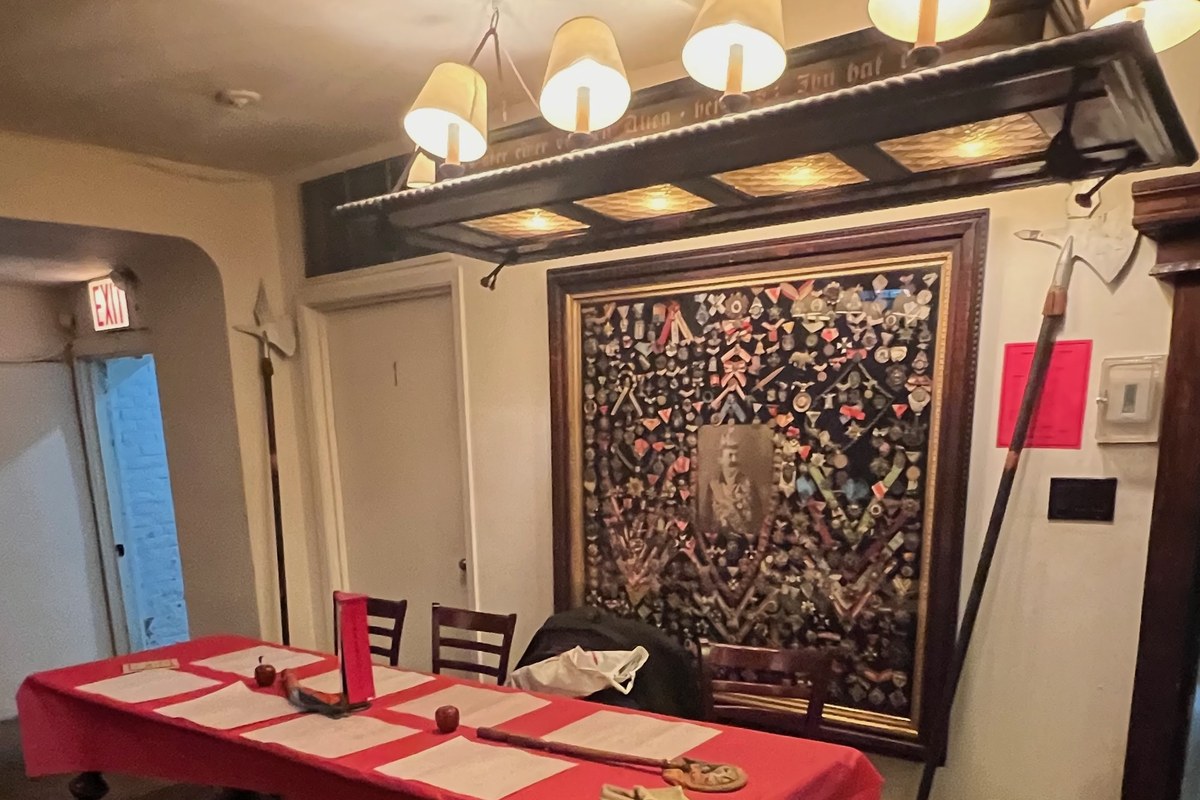
In 1977 Brooklynia took over the mother's Burg, which had fallen vacant, and consecrated it anew as the Steubenburg. Since then the Realm has met continuously at the same address in the Liederkranz house; in 1987 it moved from the fourth floor down to the basement.
Tilly
No figure shaped the Realm as Erb-Hkt. Tilly did. In 1914 he led the first ride of overseas Sassen to America, organised the European rides of the American Schlaraffen in 1925 and 1928, published the "Lose Blätter" before 1924 and, from 1925, the UHUhall — the newsletter that held the widely scattered American Realms together. At the X. Concil in Haidelberga he represented America as chief delegate, and in thanks he was crowned Ehrenschlaraffe of America. In 1941 he rose from his sickbed against medical advice to finish the American Stammrolle — and died over it. "He stayed true to the vow to be forever active for Schlaraffia."
A police band plays "Lustig bum"
When the European Schlaraffen landed in New York in 1914, they were received by the police band of the City of New York — with "Lustig bum" and "Heil Praga, Dir". This astonishing occurrence was possible, as the chronicle adds in brackets, only because the bandmaster was himself a Schlaraffe: the Brooklynia Sasse Rt Glissando.
Thin beer and the end of the duel
During Prohibition, Rt Oswaldus persuaded the American Realms that no material duel could be fought with the alarmingly thin beer that was then the only legal kind. He is said to have given the first impulse towards abolishing the material duel altogether — a reform that worked outwards from Brooklyn into the whole of Schlaraffia.
Feasts, caesuras, a farewell mid-Sippung
In 1905 Rt Knall was called to Ahalla during the Herrlichkeitsfeier, shortly after the festival bull had been read out — he remained a Schlaraffe "to his last breath". In 1939 Allschlaraffia celebrated its eightieth anniversary at Brooklynia. In 1944, in the middle of the war and despite every difficulty of travel, some two hundred took part in the 50th founding feast; its high point was Rt Arcadius's festival play "Vom Wunderland der Schönheit". In 1949 Brooklynia hosted the III. Reychstagung; in 1957 it celebrated its 2000th Sippung with thirty-two Sassen; and in the Windmond of 1969 it held its 75th founding feast.
What was lost
Archive, orders and ancestral records were kept in the home of the then Erz-Kantzler and archivist, until everything turned to ash. "Brooklynia's history went up in smoke," the chronicle says laconically. Much of what stands on this page is therefore preserved only through the volumes of Allschlaraffia — not through our own papers.
The mother goes, the daughter stays
Twice, in 1976/77 and again in 1987, a merger with Nova Yorkia was considered. Twice it foundered on the fact that neither Realm was willing to give up its identity or its location; one should not, ran the argument, "let an old and beautiful Realm die out too lightly". In 1988 Nova Yorkia nevertheless closed its gates. The mother's throne and Rostra have adorned her daughter's Burg ever since.
The Realm article in the fourth volume of the chronicle closes with a sentence we make our own: "Love, like the moon, waxes and wanes. Let us hope that Brooklynia too will again see days of greatness, as it once did, when it was one of the liveliest and best-loved Realms of North America."
Source: Chronik Allschlaraffia, volumes I to IV, Realm article No. 123.
Become part of our history?
Help write the next chapter. A single visit, with no obligation, is enough.